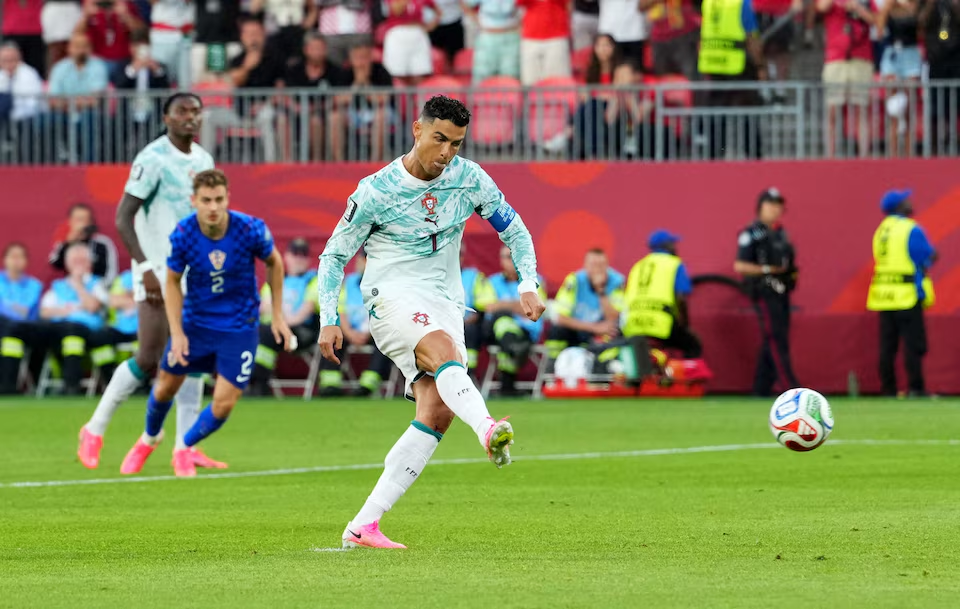
NEW YORK : Penalty shootouts have long been regarded as football’s cruellest lottery, but at the World Cup they are increasingly being treated as a specialist discipline, with teams investing heavily in psychology, preparation and data analysis to gain an edge when knockout matches go the distance.
Germany and the Netherlands paid the price for failing to prevail from the spot in Round of 32 defeats to Paraguay and Morocco, while Belgium’s Youri Tielemans completed his side’s dramatic comeback against Senegal by calmly converting a stoppage-time penalty in extra time.
For Geir Jordet, professor at the Norwegian School of Sport Sciences and author of Pressure, the idea that penalty shootouts are decided purely by luck no longer stands up to scrutiny.
“In a successful World Cup campaign, facing a penalty shootout is almost inevitable,” Jordet told Reuters.
“To not spend time on that is very strange.
“Ultimately there will be a young player whose legacy will be defined by the failure in a penalty shootout, which is a massive negative emotional trauma that we’re inflicting on this player as a coaching staff, as an FA, and even as a football industry.”
Jordet analysed every one of the 718 penalties taken in shootouts at the men’s World Cup, European Championship and Champions League from the introduction of the format in 1970 through 2023.
His research found that 53% of players who missed displayed similar body language afterwards, including making themselves appear smaller, falling to the ground, hiding their faces, looking down or avoiding teammates on the walk back.
England’s long history of shootout disappointment helped change attitudes toward preparation.
“The England story is fascinating,” Jordet said.
“They lost six out of seven penalty shootouts in the ’90s and early 2000s. And this was common knowledge in England that we go far in the tournament, we have fantastic talent, and then we lose on penalties.
“So then they took hold of this and they orchestrated something new. They created these big penalty projects. They’re very pioneering and innovative, comprehensive in their approach.”
Under manager Thomas Tuchel, England continue to place significant emphasis on penalty preparation.
“The FA has a programme in place. We follow this programme in detail, and it’s just an important and very specific part of football that comes into play in knockout matches,” Tuchel said.
Spain coach Luis de la Fuente said penalty taking was a skill that required technical and mental preparation rather than chance.
“Kicking a penalty is not something that happens at random,” he said.
“Just as we have specialists in free kicks, in corner kicks, we have specialists in penalties. Not everybody can shoot a penalty.
“We have to focus on the psychological aspect as well. For some of them, it’s much harder, and others are just eager to shoot penalties.”
As the World Cup enters its decisive stages, the penalty spot has become more than a place where tournaments are won or lost.
For many teams, it has evolved into a classroom where technique, psychology and meticulous preparation are considered as important as composure when the pressure is at its greatest.