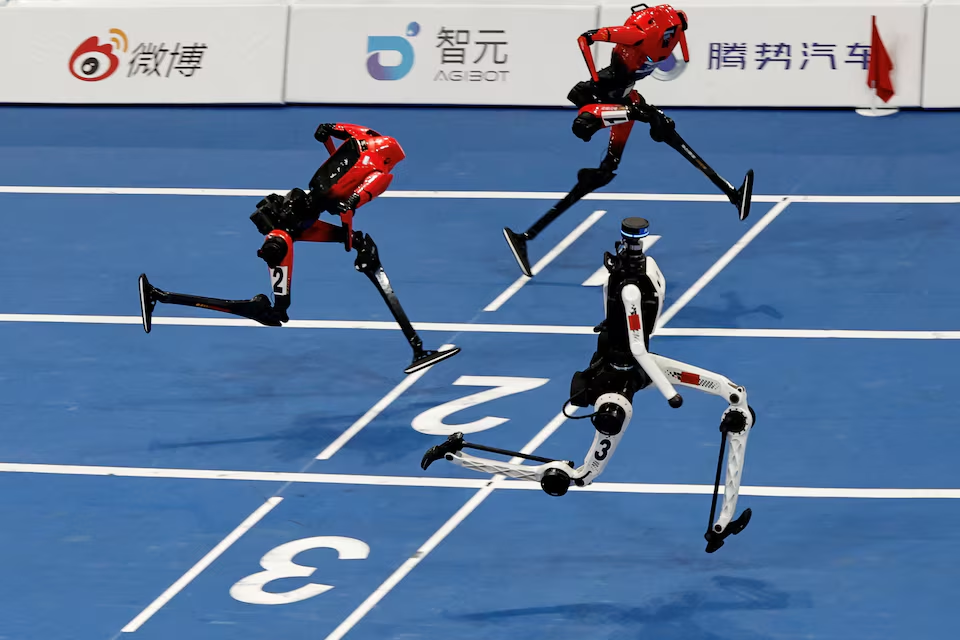
BEIJING : China’s Tiangong Ultra humanoid robot ran the 100 metres in 8.86 seconds at the World Humanoid Robot Games in Beijing on Tuesday, improving on its own 9.39-second mark set at the event’s opening.
The time was more than seven-tenths of a second faster than Jamaican sprint great Usain Bolt’s men’s human world record of 9.58 seconds, set in 2009.
Developed by the Beijing Humanoid Robot Innovation Center, Tiangong Ultra posted the time in the semifinal of the large-size robot division.
The rapid improvement of the robots has been a major attraction at the second edition of the Beijing event, where more than 2,000 robots from 666 teams are competing in 51 events, including football, dancing and industrial tasks.
Tiangong won the 100 metres at last year’s inaugural games in 21.50 seconds, and later won the world’s first humanoid robot half-marathon in Beijing in 2 hours 40 minutes.
“Reading that a motor-powered robot can run faster than a human is one thing,” said Li Hui, 26, an engineer with Fudan University’s table-tennis team. “Seeing it rush past you during training is completely different. You realise how impressive it is.”
Tiangong’s sub-nine-second run ended when it crashed into a thick mat placed beyond the finish line. A small fire broke out in its torso after the robot collapsed from the impact. In the other semifinal, another robot disassembled during the race.
Several human records surpassed
Tiangong’s latest performance followed its opening-day victory on Saturday, when it overtook Honor’s Lightning near the finish after initially falling behind. Lightning finished in 9.47 seconds, while Honor had previously recorded 9.32 seconds in a test run.
The Beijing Humanoid Robot Innovation Center said on Tuesday that its Tiangong robots had already surpassed four human world records. In addition to the 100 metres, it cited a 400-metre time of 38.15 seconds, a 1,500-metre time of 2 minutes 21.64 seconds and a high jump of 2.88 metres.
The centre’s shareholders include state-owned enterprises, investment funds, Baidu and Xiaomi’s robotics unit, according to Chinese corporate data provider Qichacha.
China has designated humanoid robots as a strategic emerging industry as companies and policymakers seek to apply advances in artificial intelligence, motors and sensors to manufacturing, logistics and services.