GLASGOW : The Commonwealth Games closed on Sunday with organisers looking to India to provide fresh momentum for the multi-sport event, after Glasgow staged a scaled-back but successful edition at short notice.
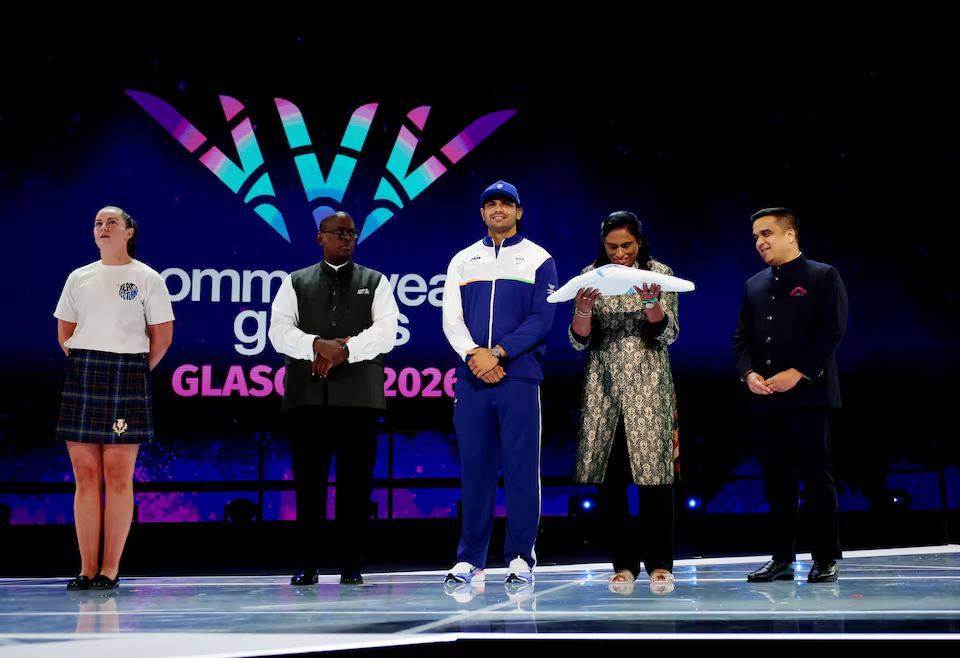
The 23rd Commonwealth Games concluded with a closing ceremony in Glasgow, ending an 11-day competition that organisers hope will provide a blueprint for a more sustainable future before the event returns to a full programme in Ahmedabad in 2030.
The Games, contested primarily by nations and territories of the Commonwealth, have faced questions over their long-term future after recent hosting difficulties. Australia’s Victoria state withdrew from staging the 2026 edition in 2023 because of rising costs, while Durban lost the right to host the 2022 Games before Birmingham stepped in.
Glasgow rescued the event by hosting a reduced programme of 10 sports, compared with the 17 to 20 featured at each of the previous six editions. The event was financed through compensation paid by Victoria following its withdrawal, together with support from Commonwealth Sport.
Organisers now hope Ahmedabad’s centenary Games in 2030 will mark a return to a more traditional format.
Commonwealth Sport chief executive Katie Sadleir said the Indian city would host an “exciting and dynamic” Games featuring between 15 and 17 sports.
Gujarat Deputy Chief Minister Harsh Sanghavi said the event would be an important step in India’s wider sporting ambitions.
“India is committed to establishing itself as a sporting capital of a global state,” Sanghavi told a media briefing.
“We aspire to host the Olympic and Paralympic Games in 2036, and the Commonwealth Games is an opportunity to demonstrate India’s readiness to deliver world-class sporting events for athletes, for spectators and for the entire world.”
While home favourite Josh Kerr, South African swimmer Chad le Clos and Australia’s dominant swim team provided standout performances in Glasgow, several leading athletes skipped the Games, including Olympic champions Julien Alfred and Keely Hodgkinson, as well as Canadian swimming star Summer McIntosh.
Organisers nevertheless highlighted the Games’ continuing role in developing emerging athletes and praised the successful integration of para-sport events into the main programme.
Despite having less than two years to prepare, Glasgow hosted around 3,000 athletes and welcomed 434,000 spectators using existing venues, with organisers saying the event cost roughly one-third of the 2014 Games held in the city.
Glasgow 2026 chief executive Phil Batty said the streamlined model had shown there was no single template for hosting the Commonwealth Games.
“We have created a belief among 74 nations that every single nation could and should host the Commonwealth Games,” Batty said.
“The Commonwealth Games, wherever it is hosted, should look and feel different and celebrate the identity, the character, the infrastructure, the communities and people of whichever nation is hosting.
“And with this new more flexible, sustainable, smarter, more inclusive approach to delivering a major sporting event, you will see every edition of the Games over the next 40 years with a different feel, dynamic and character.”