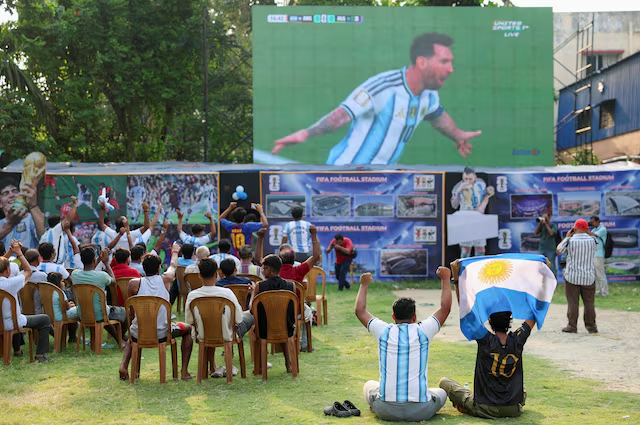
As the FIFA World Cup entered its final week, Indian software engineer Gourav Roy completed a journey of more than 6,000 miles across the United States to attend both semi-finals and the final.
For Roy, it was the closest he could come to fulfilling a childhood dream of watching India compete on football’s biggest stage.
That dream, however, appears as distant as ever. Despite a population of 1.45 billion, India are ranked 138th in the world and failed to qualify for next year’s Asian Cup, leaving hopes of a first World Cup appearance firmly out of reach.
“I’ve learned to love without expectation. That’s the burden of the Indian football fan,” Roy told Reuters.
While smaller nations such as Curacao and Cape Verde qualified for the 2026 World Cup, India’s continued absence has become a symbol of the challenges facing the sport in the country.
Administrators and club executives cite longstanding structural problems, including weak youth development, limited grassroots competition and a lack of coordination between the All India Football Federation (AIFF) and its state associations.
“If you ask me, to clean up the system and reorganise it will take a full cycle of four years,” FC Goa chief executive Ravi Puskur told Reuters.
“Then it’s another 20-25 years to get us to the World Cup.”
Football confined to regional pockets
Despite football’s popularity in states such as West Bengal, Goa, Kerala, Mizoram and Manipur, cricket continues to dominate the Indian sporting landscape.
The Indian Super League (ISL), launched in 2014 with backing from Reliance Industries, sought to broaden the sport’s appeal nationwide but has struggled to deliver sustained growth.
The AIFF and Reliance ended their partnership in 2025 after negotiations stalled amid an ongoing Supreme Court case over reforms to the federation’s constitution.
Under a new club-led management structure, the ISL has yet to announce a broadcaster or release fixtures for the upcoming season.
NorthEast United chief executive Mandar Tamhane said meaningful progress would require cooperation beyond the clubs.
“You’re talking about the government, corporate India… it has to be a collective effort,” he said.
“The federation has to make sure the clubs, state associations, the corporates and other stakeholders all work together.”
Youth system under scrutiny
AIFF executive committee member and Mizoram sports minister Lalnghinglova Hmar said improving youth development was essential if India hoped to compete with Asia’s leading football nations.
“In South Korea and Japan, kids play over 40 competitive matches per season. This is missing in India,” Hmar said.
“We start developing players too late. Most Under-15 players get only 12 to 15 competitive games yearly. Some get called up to the youth national camp after playing less than 20 competitive games.
“We’re short on qualified coaches. Many states don’t even have a youth league… we just can’t compete like that.”
Hmar said governments could assist by investing in infrastructure, but stressed that sustained reform of coaching pathways and youth competitions was needed to raise standards.
India’s vast size, which has helped make it one of the world’s biggest sports markets and fuelled the success of cricket’s Indian Premier League, also presents logistical challenges for implementing nationwide football reforms.