MIAMI : FIFA introduced video technology to reduce controversy at the World Cup, but the 2026 tournament has instead produced a fresh wave of debate over whether the Video Assistant Referee (VAR) system has expanded beyond its original purpose.
From disputed offside decisions to overturned goals and retrospective red cards, technology has featured prominently in many of the tournament’s biggest talking points, prompting criticism from players, coaches and football associations over the consistency of its application.
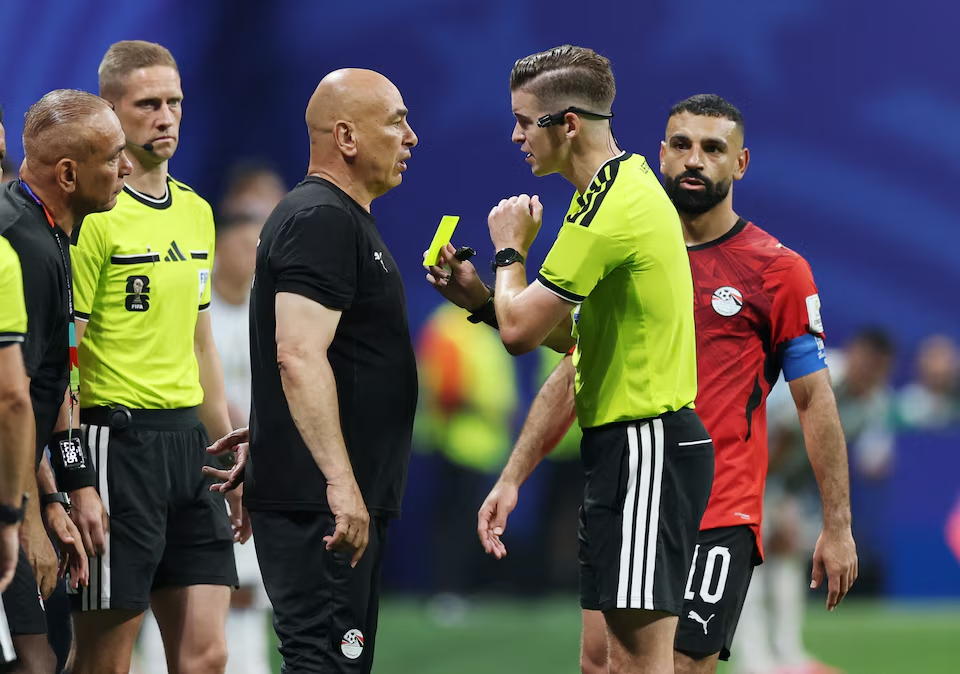
Among the most contentious incidents came in Argentina’s 3-2 victory over Egypt in the round of 16, where Egypt had a goal disallowed following a VAR review for a foul earlier in the attacking phase before later seeing a penalty appeal rejected.
After the match, Egypt coach Hossam Hassan questioned the officiating and suggested the system had been applied inconsistently.
FIFA’s head of refereeing, Pierluigi Collina, rejected those claims, defending the decision to overturn Egypt’s goal.
“There is no defined limit regarding either the distance from goal or the amount of time between the incident and the goal,” Collina said in an interview published by FIFA.
“We believe that a foul is a foul. Regardless of whether the foul appears ‘obvious’, if the referee did not see it on the field of play, the VAR can intervene.”
VAR was originally introduced to correct “clear and obvious” errors, with its first World Cup use coming in Russia in 2018 after FIFA president Gianni Infantino backed the technology following years of resistance under his predecessor Sepp Blatter.
There were 20 VAR interventions during the 64 matches at the 2018 World Cup and fewer than 30 during the same number of games in Qatar in 2022.
This year’s expanded 104-match tournament has already seen those totals surpassed, reflecting FIFA’s decision, made alongside the International Football Association Board (IFAB), to widen the circumstances in which VAR can intervene.
The increased use of technology has also divided opinion among analysts and supporters.
Brennan Klein, a network scientist at Northeastern University whose team has analysed officiating data during the tournament, said supporters appeared increasingly frustrated by frequent reviews.
“This kind of dystopian future of over-refereeing everything kind of fails to address what it’s originally designed to intervene on,” Klein told Reuters.
“My sense is that fans in the stadium, by and large, just hate this.”
Another flashpoint came during Croatia’s round-of-32 defeat by Portugal, when Josko Gvardiol had a stoppage-time equaliser ruled out after a sensor embedded in the match ball detected a slight touch from teammate Igor Matanovic, resulting in an offside decision.
FIFA said the technology enabled officials to identify even minimal contact and make quicker, more accurate decisions.
Croatia captain Luka Modric, however, questioned whether technology was being used appropriately.
“For some things it’s useful, but it’s either being used incorrectly or selectively, depending on the size of the team or whatever else,” Modric said.
“If it’s a 200% mistake, then you intervene. If it’s not, if it’s in a grey area, then there’s no reason to get involved.”
The Croatian Football Federation later requested an explanation from FIFA, describing the decision as “an abuse of technology”.
The tournament has also seen an increase in red cards following VAR intervention.
According to data cited by Reuters, 13 players had been sent off by the end of the round of 16, more than three times the total at either the 2018 or 2022 World Cups, although the 2026 tournament features significantly more matches.
Among the dismissals were those of United States forward Folarin Balogun and England defender Jarell Quansah, both of whom were shown red cards after incidents initially missed by the on-field referee.
The Balogun decision also drew attention outside football after U.S. President Donald Trump said he had contacted Infantino in support of an appeal against the player’s suspension, although the FIFA president later said he had played no role in the outcome.
England manager Thomas Tuchel also criticised VAR after his side’s 3-2 victory over Mexico in the round of 16, arguing that the system had exceeded its intended remit.
“VAR overturns (but) is this a clear and obvious error for the penalty? For sure not,” Tuchel said.
“They overturned a situation where (the referee) doesn’t even give a foul. Referees just not good enough, fourth officials just not good enough.”